
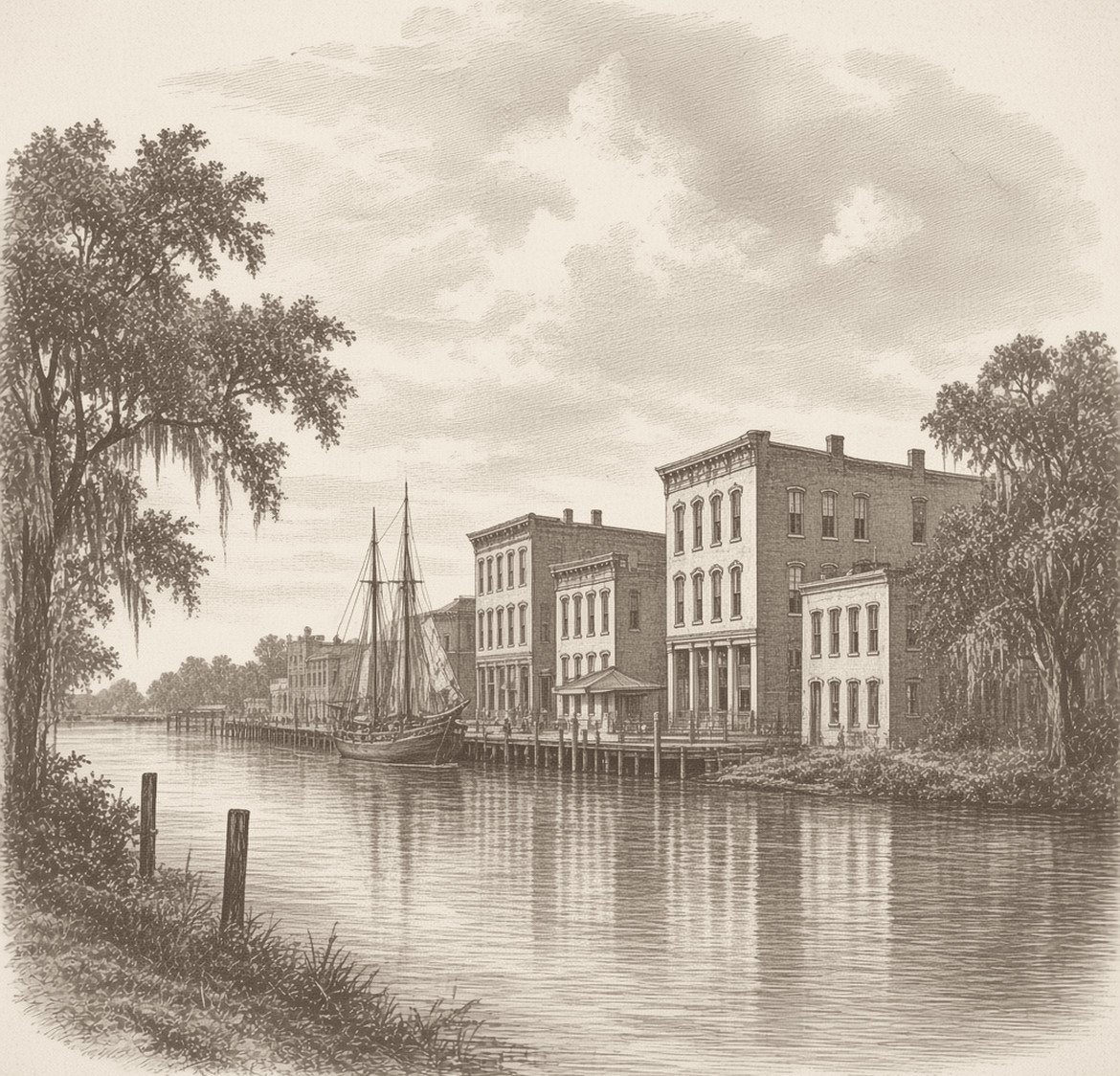
A Port Among the Pines
In the early 1730s settlers laid out a town where the Cape Fear’s two northern branches meet, thirty miles upriver from the sea. Called New Carthage, New Liverpool and then Newton, it was chartered in 1740 as Wilmington, after Spencer Compton, Earl of Wilmington. Barrels of tar, pitch and turpentine from the longleaf pine forests floated down to its wharves, bound for Britain’s shipyards. Much of that work fell to enslaved people, who by 1767 made up more than 60 percent of the Lower Cape Fear’s population.
In October 1765 some 500 townspeople burned an effigy of a Stamp Act supporter and drank to “Liberty, Property, and no Stamp Duty.” On Halloween they staged a mock funeral for Liberty, only to find she still had a pulse.
Running the Blockade
When the Civil War came, Union warships closed in on the Southern coast, but Wilmington stayed open. Sleek, shallow-draft steamers slipped past the blockade, carrying cotton out to Bermuda and Nassau and bringing back food, clothing and munitions. Fort Fisher, a vast earthen fort near the river’s mouth, held the Union fleet at bay. By late 1864 Wilmington was the Confederacy’s last major open port and a lifeline for Robert E. Lee’s army.
On January 15, 1865, after one of the heaviest naval bombardments in history to that time, Fort Fisher fell. Union troops entered the city on February 22. One teenage purser aboard the blockade runners, James Sprunt, would one day call Orton home.
Liberty Ships and a Battleship
World War II brought the city its biggest boom yet. The North Carolina Shipbuilding Company launched its first Liberty ship on December 6, 1941, the day before the attack on Pearl Harbor. At its peak in 1943 the yard employed 21,000 people, and by war’s end it had built 243 ships.
In 1961 nine tugboats towed the battleship USS North Carolina, winner of 15 battle stars in the Pacific, to a berth across the river from downtown. Dedicated in April 1962 as a memorial to the more than 11,000 North Carolinians who died in the war, she still keeps watch over the waterfront. In 2020 Wilmington was named the nation’s first World War II Heritage City.
Azaleas and Hollywood East
In April 1948 Wilmington held its first North Carolina Azalea Festival, with garden tours to Airlie, Greenfield Lake and Orton. Each spring since, the azaleas have brought the city out to celebrate.
In 1983 producer Dino De Laurentiis brought Stephen King’s Firestarter here after his colleague Frank Capra Jr. spotted Orton in a Southern magazine. He liked Wilmington so much that he built a studio, and “Hollywood East” was born. Meanwhile, decades of restoration preserved a downtown historic district of more than 230 blocks, and in 2017 the city completed its 1.75-mile Riverwalk.
Nearly three centuries after Newton rose on this riverbank, Wilmington still welcomes travelers who arrive by way of the Cape Fear. We hope you’ll wander the Riverwalk, linger over dinner downtown, and make this old port city your home for our weekend.